
Customer feedback is one of the clearest ways to see what energy efficient home improvements change in daily life. A homeowner recently told us his home felt warmer and more efficient almost as soon as our team finished. That result is not down to luck. It comes from choosing the right upgrade, fitting it with care and finishing the job when promised.
Below, we share his feedback in full. We then use it to answer the questions homeowners ask us most often. How quickly should you notice a difference? How can you check that an upgrade has really improved home warmth and efficiency? And how do you know whether Greentek reviews, or any installer's reviews, are worth trusting?
Key Facts at a Glance
| Question | Short answer |
|---|---|
| Who left this feedback? | James Walker, a homeowner from Manchester. He sent it to us by email and agreed to us publishing it. |
| What did he highlight? | Professional work, a job finished on time and a warmer, more efficient home almost straight away. |
| How soon does insulation make a difference? | Usually from the first cold evening after the work is complete. |
| When can you judge running costs fairly? | After a full heating season, comparing energy use in kWh rather than pounds. |
| Where does heat escape from an uninsulated home? | Up to a third through the walls and around a quarter through the roof. |
| Who carries out Greentek's work? | Our own in-house teams. Every installer is MCS and TrustMark certified. |
| Where does Greentek work? | Homes and businesses across the West Midlands and Wales. |
What Did Our Customer Say?
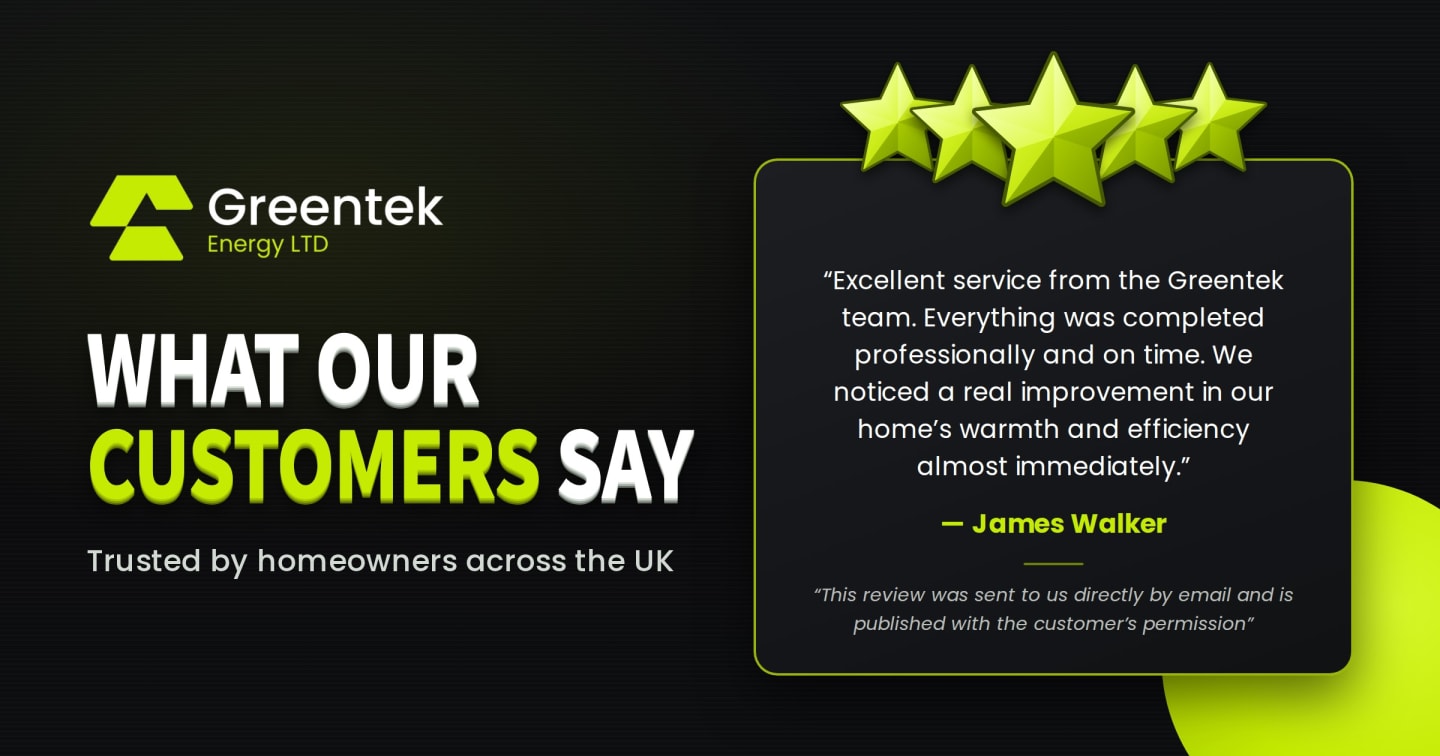
"Excellent service from the Greentek team. Everything was completed professionally and on time. We noticed a real improvement in our home's warmth and efficiency almost immediately."
James Walker, Manchester
This review was sent to us directly by email and is published with the customer's permission.
It is a short review. Even so, it covers the three things homeowners tell us matter most. Was the work done properly? Did it finish when promised? Did the house actually feel different afterwards? The sections below look at each point and what it means if you are planning similar work on your own home.
What Does This Feedback Tell You About an Energy Upgrade?
Good feedback after an energy upgrade usually reflects three things working together. The improvement suited the property. It was installed carefully. The project was well run from start to finish. If any one of these is missing, the result often falls short, even when the product itself is good.
What Does "Completed Professionally" Look Like on Site?
Professional work is easy to praise and harder to define. In practice, it shows up in small details you can check for yourself.
- Floors, furniture and driveways are protected before any work starts.
- You know what is happening each day and who will be on site.
- Insulation is fitted without gaps, because even small gaps leave cold spots.
- New heating systems are tested and set up before the team leaves.
- The site is cleared and the paperwork is handed over in full.
Workmanship matters more with energy upgrades than with many other home improvements. A loft with insulation missing around the hatch will lose heat at that point. Wall insulation with poorly sealed joints can let in damp and cold. These details decide whether a home actually feels warmer or only looks finished.
Why Does Finishing on Time Matter So Much?
Delays on energy work cost more than patience. If your heating system is being replaced, each extra day can mean cold rooms and no hot water. Scaffolding for external wall insulation is often hired by the week. Render also needs the right conditions and should not go on in frost or heavy rain, so a missed weather window can push a job back.
Finishing on time depends on what happens before anyone arrives. That means a proper survey, the right materials ordered in advance and a schedule that allows for the weather. When a customer says the work was done on time, it usually means the planning was right.
Is It Realistic to Feel Warmer "Almost Immediately"?
For many upgrades, yes. Insulation and draught-proofing start working as soon as they are in place. The change is usually most obvious on the first cold evening. Rooms hold their heat for longer after the heating switches off, and walls no longer feel cold to the touch.
Lower running costs take longer to prove. One week of meter readings tells you very little because the weather changes so much from week to week. To judge efficiency fairly, you need to compare a full heating season with the one before it. We explain how to do that later in this guide.
Which Upgrades Make a Home Feel Warmer Straight Away?
Upgrades that cut heat loss, such as loft and wall insulation, tend to improve comfort fastest. A heating upgrade improves warmth from the day it is commissioned, although a heat pump can take a few weeks to fine-tune. Solar PV lowers electricity costs but does not directly make rooms warmer.
| Upgrade | When you usually notice warmer rooms | When you can judge running costs | Worth knowing |
|---|---|---|---|
| Loft insulation | The first cold night | After one heating season | The Energy Saving Trust recommends at least 270mm |
| External wall insulation | The first cold spell | After one heating season | Suits solid walls that cannot take cavity insulation |
| Heating system upgrade | The day it is commissioned | After one heating season | Controls and radiator sizes affect the result |
| Air source heat pump | Within a few weeks as settings are tuned | After one heating season | Gives steady heat at a lower temperature |
| Solar PV | Not directly, as it does not heat rooms | From the first few months | Savings depend on how much power you use in daylight |
Insulation: The Quickest Route to a Warmer Home
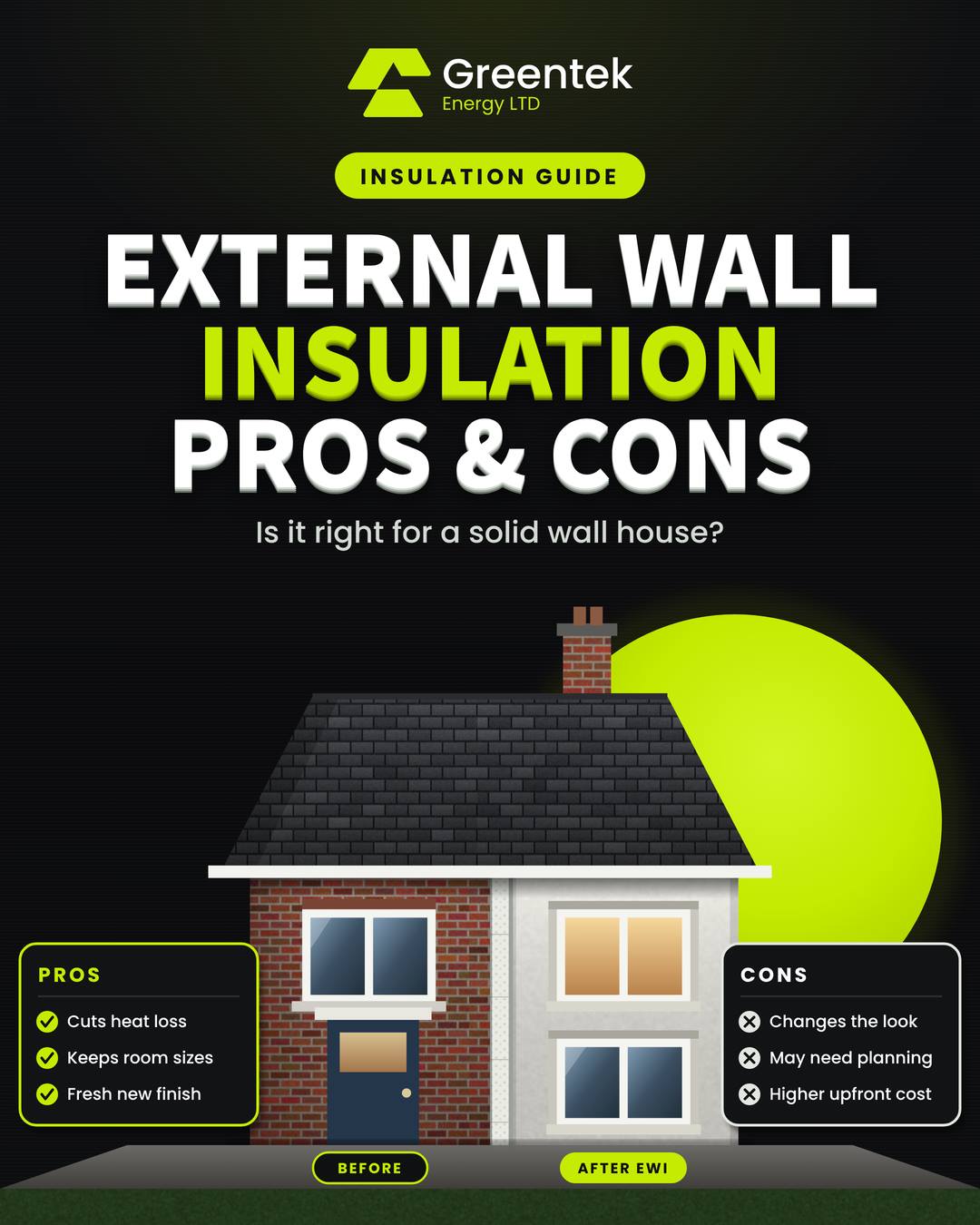
Coventry City Council estimates that an uninsulated home can lose up to a third of its heat through the walls and around a quarter through the roof. The Energy Saving Trust gives a similar figure of about 25% for roofs. That is why insulation is often where homeowners notice the biggest change in comfort.
Loft insulation is usually one of the quickest jobs we do and can often be finished in a single day. Many older homes in the West Midlands and Wales have solid walls with no cavity to fill. For these, external wall insulation and rendering wraps the outside of the house in an insulating layer. Inside, the walls stop feeling cold and rooms lose heat more slowly.
Heating Upgrades: Comfort That Feels Different
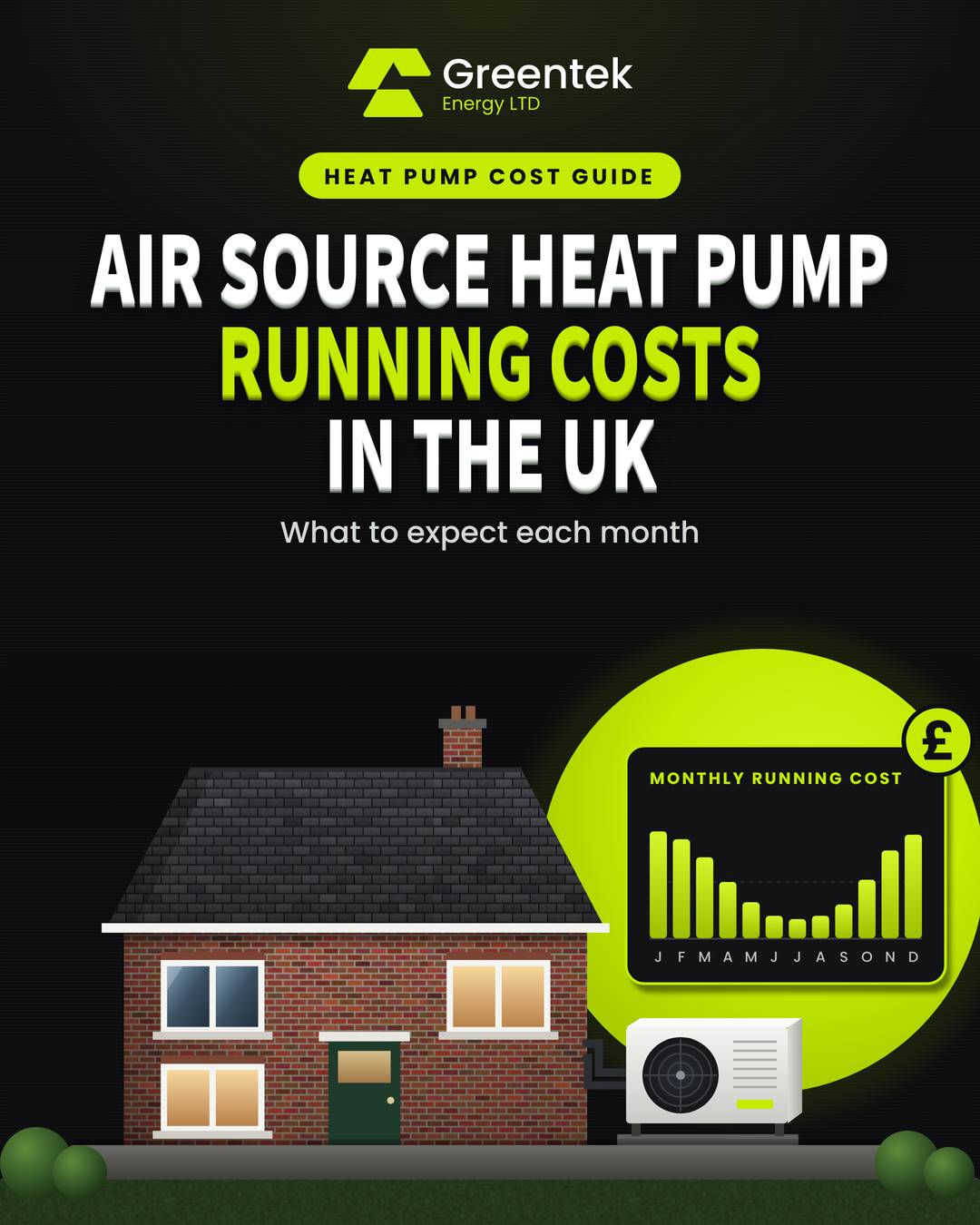
A modern heating system often feels different, not just warmer. A heat pump works most efficiently when it runs steadily at a lower temperature. Radiators feel warm rather than hot, but the house stays at a more even temperature through the day.
What Should You Expect in the First Few Weeks?
Some homeowners worry when radiators are not hot to the touch. With a well-designed heat pump system, this is normal. The first few weeks are a settling-in period. Your installer may adjust the settings once they see how the house responds in colder weather.
We size every system using a room-by-room heat loss calculation, so each room gets the heat it needs. You can find out more on our air source heat pump installations page.
Solar PV: Lower Bills Without Extra Warmth
Solar panels generate electricity, not heat. They will not make a cold room warmer on their own. What they can do is reduce the electricity you buy from the grid. This matters more if you run a heat pump or use a lot of power during the day. It is worth being clear on this before you decide which upgrade to start with.
How Can You Check That Your Home Is Warmer and More Efficient?
Take simple readings before the work starts. Afterwards, compare your energy use in kWh over the same months and allow for the weather. Alongside the numbers, note how the rooms feel, how quickly they warm up and whether condensation has reduced.
Step 1: Record a Starting Point Before Work Begins
A few minutes of note-taking now makes the results much easier to judge later.
- Take gas and electricity meter readings at the same time each week.
- Write down your thermostat setting and heating schedule.
- Check the temperature in your coldest room, morning and evening, with a simple room thermometer.
- Photograph any condensation, damp patches or mould.
Step 2: Compare kWh, Not Pounds
Your bill in pounds is a poor measure of efficiency because unit prices keep changing. Ofgem updates the energy price cap every three months. From 1 October 2026 the cap rose by 4%, taking a typical dual fuel bill to £1,723 a year. A home could use less energy than last year and still receive a higher bill.
Your smart meter display or online energy account shows usage in kWh. That is the fairer number to compare.
Step 3: Allow for a Colder or Milder Winter
A cold winter will always use more heat than a mild one. Heating degree days help you account for this. They measure how cold a period was compared with a base temperature, which in the UK is usually 15.5°C. The colder the period, the more degree days it has.
To compare like with like, divide the energy used for heating by the number of degree days for the same period. Free degree day figures for your area are available online.
A Simple Worked Example
The figures below are for illustration only. They show how the method works rather than the result of any particular project.
| Period | Gas used for heating | Heating degree days | kWh per degree day |
|---|---|---|---|
| Winter before the upgrade | 9,000 kWh | 1,500 | 6.0 |
| Winter after the upgrade | 7,800 kWh | 1,560 | 5.0 |
The second winter was colder, yet the home used less energy for each degree day. That points to an improvement in efficiency of about 17%, which a simple bill comparison could easily hide.
Step 4: Notice How the Home Feels
Numbers tell part of the story. Comfort tells the rest. Signs that an upgrade has given you a warmer home include:
- Rooms reach the thermostat setting more quickly.
- The temperature drops more slowly overnight.
- Walls and corners no longer feel cold to the touch.
- There is less condensation on the windows in the morning.
- You have turned the thermostat down and not noticed.
What If Your Home Still Feels Cold After an Upgrade?
Start with the basics. Check the heating controls, where the thermostat is placed and whether insulation has been disturbed. If the problem continues, the upgrade may have tackled the wrong source of heat loss, or the heating may need adjusting. Speak to your installer, as most issues are quick to diagnose.
Common Causes We Come Across
- Heat is escaping elsewhere. A well-insulated loft will not stop heat loss through solid walls or a suspended timber floor.
- Loft insulation has been squashed. Boxes stored on top compress the material. Compressed insulation traps less air and works less well.
- The thermostat is in the wrong place. A thermostat in a sunny hallway or next to a radiator switches the heating off too early.
- The heat pump is being used like a boiler. Turning it on and off in short bursts makes it work harder. Steady running is usually more comfortable and cheaper.
- Draughts remain. Gaps under skirting boards, an unused chimney or a letterbox can undo some of the benefit.
If you want to understand the wider causes, our guide on why a house can feel cold even with the heating on explains them in more detail.
What Good Aftercare Looks Like
A good installer does not disappear once the invoice is paid. At handover, we take you through how everything works, clean up and give you your written warranty. For heat pumps and solar PV, you also receive your MCS certificate. If something is not right after we finish, we come back and fix it free of charge.
You can read a step-by-step overview of how our home energy improvement process works, from the first call to aftercare.
How Can You Tell If Installer Reviews Are Worth Trusting?
A useful review describes what happened. It mentions how the team worked, whether the job finished on time and what changed afterwards. Check any installer's reviews against public registers such as TrustMark and MCS. Then ask direct questions before you sign anything.
Look for Specific Details
A five-star rating with no detail tells you little. A review that mentions timing, workmanship and results gives you something you can test. James's review covers all three. Use the same test on Greentek reviews as you would on anyone else's. Timing, workmanship and results are fair questions to put to any installer you are considering.
Check Accreditation Yourself
- TrustMark is the government-endorsed quality scheme for work done in and around the home. You can search its register online.
- MCS certifies installers of heat pumps and solar PV. You need an MCS certified installer to claim the Boiler Upgrade Scheme grant.
- Gas Safe Register is the official list of engineers who are legally allowed to work on gas appliances.
Greentek's installers are MCS and TrustMark certified, and we are on the Gas Safe Register. These registers are public and quick to search, so you do not need to take our word for it.
Questions to Ask Before You Sign
- Will your own team do the work, or will it be subcontracted?
- When can you start, and how long will the job take?
- What exactly does the quote include?
- What warranty is provided, and who provides it?
- Who handles certificates, building control and any grant paperwork?
- What happens if something is not right after you finish?
An installer who answers these clearly and in writing is usually one you can rely on. Our article on why experience matters when choosing an energy efficiency company covers this in more depth.
Planning Energy Efficient Home Improvements With Greentek
James's feedback reflects what we aim for on every job: honest advice, careful work and a home that is more comfortable to live in. If you are planning energy efficient home improvements, a few simple steps will help you get a similar result.
- Take baseline readings now, before any work begins.
- Ask for a survey that looks at the whole house, not just one product.
- Check your installer's accreditation on public registers.
- Judge the results over a full heating season, using kWh.
Greentek Energy Ltd works with homeowners and businesses across the West Midlands and Wales. Our in-house teams cover insulation, heating, heat pumps, solar PV and renovation, so one team can look at your whole property. If you would like to talk through your home, book a free survey. We will tell you honestly which changes are likely to make the biggest difference.