
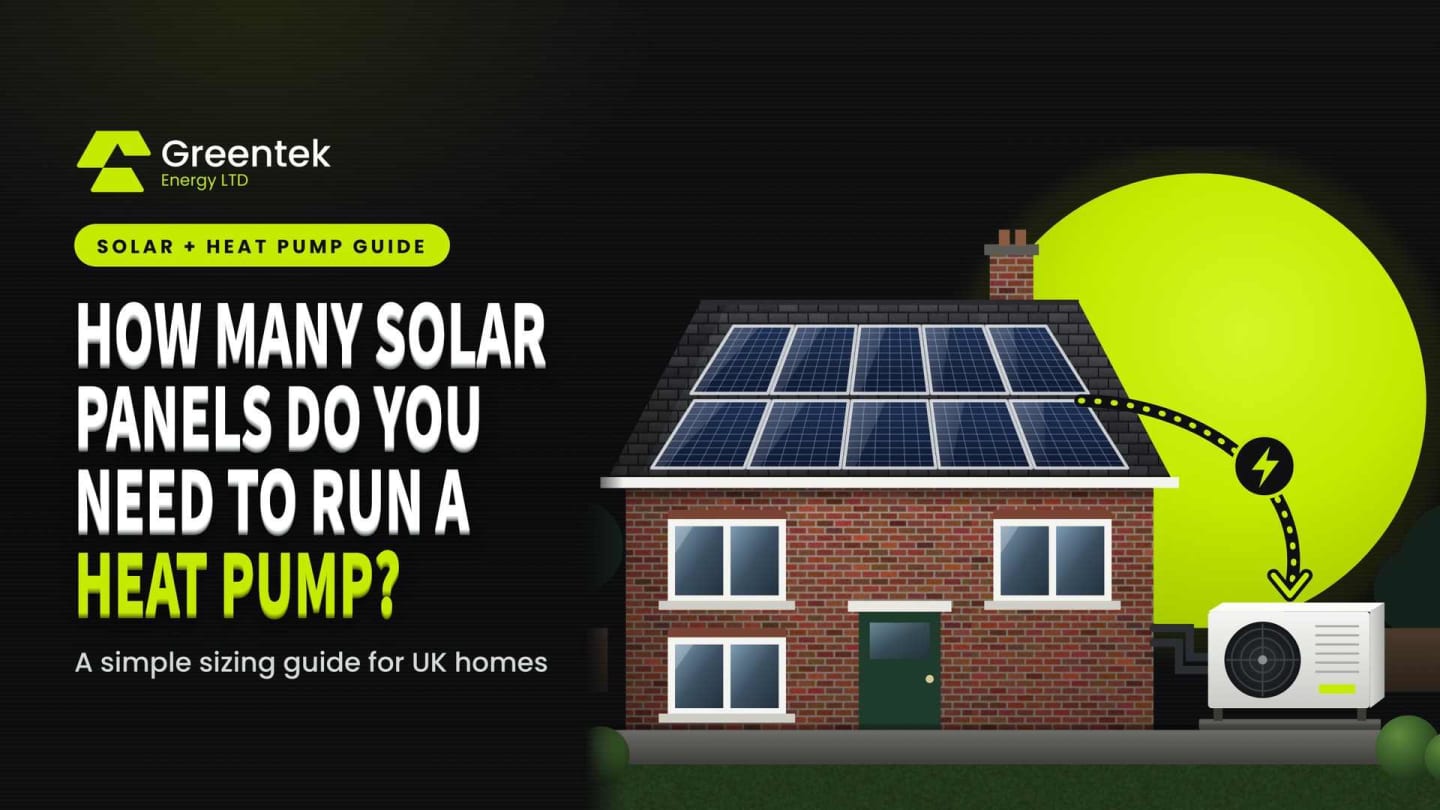
For a typical UK home, around 8 solar panels will generate as much electricity over a year as an air source heat pump uses. That is roughly a 3.4 kWp system. The catch is timing. Solar panels produce most of their power in summer, while a heat pump does most of its work in winter. So knowing how many solar panels to run a heat pump is only half the answer. The other half is how the two systems work together through the year.
This guide explains how to work out the right number of panels for your home, what to expect from your panels in winter, when a battery makes sense and what savings are realistic. The figures are based on current UK energy prices and solar output data for the West Midlands and Wales, where we install both systems.
Key Facts at a Glance
| Question | Short answer |
|---|---|
| Panels to cover a typical heat pump's yearly use | About 8 panels of 430W, or roughly 3.4 kWp |
| Panels to cover the heat pump and the rest of the house | About 15 panels, or roughly 6.5 kWp |
| Typical heat pump electricity use | Around 2,000 to 4,700 kWh a year, depending on the size and condition of the home |
| Yearly solar output in Birmingham | About 870 kWh for every kWp of panels |
| Winter vs summer output | A 4 kWp system makes around 2 to 5 kWh a day in December and 15 to 22 kWh in June |
| Can solar run a heat pump in winter? | Only partly. Most winter heating electricity still comes from the grid |
| Electricity price (October to December 2026) | 26.32p per kWh under the Ofgem price cap |
How Many Solar Panels to Run a Heat Pump: The Short Answer
There are two ways to read the question, and they give very different answers.
The first is: how many panels will produce the same amount of electricity in a year as my heat pump uses? For most homes, that is somewhere between 6 and 13 panels. A typical home needs about 8.
The second is: how many panels will power my heat pump on a cold January evening? The honest answer is that no realistic number of panels on a house roof can do that. The sun has set by the time most homes need heat, and winter output is low even at midday.
That is why we rarely size solar around the heat pump alone. We size it around the whole home's electricity use, the space on your roof and how much of the power you can use yourself. Then we look at whether a battery and a cheaper overnight tariff can cover the winter gap.
How Much Electricity Does a Heat Pump Use?
Heat pump electricity use depends on two things: how much heat your home needs, and how efficiently the heat pump makes it.
Efficiency is measured as SCOP, which stands for seasonal coefficient of performance. It tells you how many units of heat the heat pump produces for each unit of electricity over a whole year. According to Which?, a typical SCOP in UK homes is around 3.0. In other words, one kWh of electricity gives you about three kWh of heat.
Ofgem's figure for typical household gas use is 9,500 kWh a year. A gas boiler turns most of that into heat, so a typical home needs roughly 8,000 to 8,500 kWh of heat a year for heating and hot water. Divide that by a SCOP of 3 and the heat pump uses around 2,800 kWh of electricity a year.
What Affects Your Heat Pump Electricity Use?
Two homes with the same heat pump can use very different amounts of electricity. The main factors are:
- Insulation and draughts. The less heat your home loses, the less the heat pump has to make.
- Flow temperature. Heat pumps work most efficiently when they heat water to a lower temperature, such as 35 to 45°C, rather than the 60 to 70°C many boilers run at.
- Weather compensation. This control adjusts the flow temperature to the weather outside. In one Energy Saving Trust case study, turning it on cut the homeowner's heat pump energy use by more than a quarter.
- Hot water use. Larger households with more baths and showers use more.
- How you run it. Heat pumps prefer steady, low-level heating to short bursts at high power.
Why a Proper Heat Loss Calculation Matters
The most reliable way to estimate how much electricity your heat pump will need is a room-by-room heat loss calculation. It is part of every heat pump survey we carry out, and you can read more about it in our guide to how our home energy improvement process works. Without that figure, any solar sizing is guesswork.
How Much Electricity Does One Solar Panel Produce in the UK?
Most new home solar panels are rated at around 400 to 450 watts. The panels used in our solar PV installations come from manufacturers such as AIKO, JinkoSolar and Trinasolar. For the sums in this guide we use a 430W panel, which is about 1.7 metres tall and just over 1 metre wide.
Regional figures published by Voltflow in 2026 put yearly output in Birmingham at about 870 kWh for every kWp (kilowatt peak) of panels, with South Wales producing a little more at 870 to 950 kWh. A 430W panel is 0.43 kWp, so in the West Midlands it produces roughly 375 kWh a year if it faces south with no shading.
Your actual output depends on:
- Direction. South-facing roofs produce the most. East and west roofs typically produce less, but spread generation across the morning and evening.
- Pitch. A slope of around 30 to 40 degrees is ideal in the UK.
- Shading. Chimneys, trees and nearby buildings can cut output, especially in winter when the sun is low.
Solar Panels' Winter Output in the UK
This is where expectations often go wrong. Solar panels' winter output in the UK is a small fraction of what they make in summer. Voltflow's figures show a 4 kWp south-facing system producing around 15 to 22 kWh a day in June but only 2 to 5 kWh a day in December.
| Month | Daily output from a 4 kWp system | What that means |
|---|---|---|
| June | 15 to 22 kWh | More than most homes can use during the day |
| December | 2 to 5 kWh | Enough for a few hours of household appliances, not heating |
Panels still work on cloudy days because they use daylight, not heat. Cold weather even helps them run slightly more efficiently. The limit is simply the short, grey days of a British winter.
How to Work Out the Number of Panels You Need
You can get a reasonable estimate in four steps. A survey will refine it, but this gives you a sensible starting point.
Step 1: Estimate How Much Electricity Your Heat Pump Will Use
Take your home's yearly heat demand and divide it by the heat pump's SCOP. If you are replacing a gas boiler, your past gas bills are a good guide. Multiply your yearly gas use in kWh by about 0.85 to 0.9 to get your heat demand, then divide by 3.
Step 2: Add the Rest of Your Household Electricity
Your lights, cooking and appliances use electricity too. Ofgem's typical figure is 2,500 kWh a year, but check your own bills. Adding this gives your total yearly electricity use after the heat pump goes in.
Step 3: Divide by What One Panel Produces
In the West Midlands, divide your total by about 375 kWh. That gives the number of 430W panels needed to match your yearly use. In South Wales, you may need slightly fewer.
Step 4: Check Your Roof and Grid Connection
Many roofs simply do not have space for 15 or more panels on a south-facing slope. A system with an inverter rated above 3.68 kW per phase also needs approval from your local electricity network operator before it can be connected. This is known as a G99 application and can take several weeks, so it is worth starting early. Smaller systems usually only need a notification after installation.
Example Sizes for Different Homes
The table below uses the assumptions above: a SCOP of 3, 2,500 kWh of household electricity and 430W panels producing 375 kWh each a year.
| Type of home | Yearly heat needed | Heat pump electricity | Panels to match the heat pump | Panels to match the heat pump and household use |
|---|---|---|---|---|
| Smaller or well-insulated home | 6,000 kWh | 2,000 kWh | 6 panels (2.6 kWp) | 13 panels (5.6 kWp) |
| Typical home (Ofgem average gas use) | 8,500 kWh | 2,800 kWh | 8 panels (3.4 kWp) | 15 panels (6.5 kWp) |
| Larger or older home | 14,000 kWh | 4,700 kWh | 13 panels (5.6 kWp) | 20 panels (8.6 kWp) |
These are estimates for planning, not quotes. Your own figures depend on your heat loss, your roof and how you use energy.
Can Solar Panels and a Heat Pump Work Together in Winter?
Yes, but solar will only cover a small part of the heat pump's winter needs. Running solar panels and a heat pump together still lowers your bills over the year. Most of the benefit, though, comes in spring, summer and autumn, when the panels produce more than the house can use and the heat pump is mainly heating hot water.
The table below shows how a typical home's heat pump use compares with output from a 4 kWp system, which is about 9 panels. Heat pump figures are our estimates for a typical home.
| Time of year | Heat pump electricity per day | Solar output per day | Result |
|---|---|---|---|
| Midwinter (December and January) | 15 to 20 kWh | 2 to 5 kWh | Most heating power comes from the grid |
| Spring and autumn | 2 to 3 kWh | 15 to 22 kWh | Solar covers hot water easily, with plenty left to export |
What Happens on a Cold, Grey Day in January?
On a cold January day, your heat pump may need 15 to 20 kWh of electricity. Your panels might produce 2 to 5 kWh, mostly between 10am and 2pm. That covers roughly 10% to 30% of the heat pump's needs on that day, and less when it is overcast.
The Energy Saving Trust's case study of Tim, a homeowner in Somerset with solar panels, batteries and a heat pump, makes the same point. In his words, solar produces "the vast majority of the electricity in the summer" and "much less in winter, when you do need it." Over 2024, his panels generated about 6,580 kWh, which covered roughly half of his home's total use of 12,780 kWh.
Where Solar Helps Most
Solar earns its keep in three ways when paired with a heat pump:
- Hot water in summer. A heat pump can heat your hot water cylinder during the day using free solar power.
- Spring and autumn heating. Mild, bright days are when panels and heating demand overlap most.
- Everything else in the house. Every kWh of solar you use yourself is a kWh you do not buy, whatever it powers.
Do You Need a Solar Battery for a Heat Pump?
You do not need one, but a solar battery for a heat pump can make a real difference to how much of your solar power you use and how much you pay in winter.
In summer, a battery stores daytime surplus for the evening. In winter, when there is little surplus, a battery can charge overnight on a cheaper time-of-use tariff and then power the house and heat pump during the expensive peak hours. For many heat pump owners, this winter role is worth as much as the solar storage itself.
Battery Capacity vs Inverter Power
Home batteries usually hold between 5 and 13.5 kWh. Capacity matters, but so does the inverter's power rating, which limits how fast the battery can supply electricity.
Energy Saving Trust research on homes with heat pumps, solar and batteries found one case where the battery could only deliver about 2.5 kW. The heat pump drew around 3 kW when starting, so it could not run fully from the battery. If you are adding a solar battery for a heat pump, ask your installer to check both the battery size and the inverter rating against the heat pump's peak demand.
Pairing a Battery With a Time-of-Use Tariff
Several energy suppliers offer tariffs designed for heat pumps or batteries, with cheaper electricity at set times of day. A battery lets you buy more of your electricity in those cheaper windows. Tariffs change often, so compare them when your system is commissioned.
Batteries currently qualify for 0% VAT in Great Britain, including when added to an existing solar system. The zero rate for energy-saving materials is due to run until 31 March 2027.
How Big Are Heat Pump and Solar Savings?
Heat pump and solar savings come from two places: the solar power you use yourself, and the surplus you sell back to the grid.
Every kWh you use yourself saves you the full price of electricity. Under the Ofgem price cap for October to December 2026, that is 26.32p per kWh. Electricity also carries no VAT between 1 October 2026 and 31 March 2027.
Surplus power exported to the grid is paid through the Smart Export Guarantee (SEG). Which? found export rates ranging from 1p to 25p per kWh in April 2026, although the highest rates usually require you to buy a battery or be an existing customer. The best rate open to anyone at the time was 6p per kWh. Your system must be MCS certified to claim SEG payments.
A Worked Example
The figures below are for illustration only. They assume an 8-panel system producing about 3,000 kWh a year, electricity at 26.32p per kWh and an export rate of 6p per kWh.
| Set-up | Solar used at home | Solar exported | Estimated yearly value |
|---|---|---|---|
| Solar without a battery (about 40% used at home) | 1,200 kWh, worth about £315 | 1,800 kWh, worth about £108 | About £420 |
| Solar with a battery (about 70% used at home) | 2,100 kWh, worth about £550 | 900 kWh, worth about £54 | About £605 |
This does not include extra savings from charging a battery on a cheap overnight tariff, which can be significant in winter. In Tim's case, the Energy Saving Trust reports that he saved about £1,200 in 2024 by using variable tariffs alongside his solar and batteries.
Get the Order Right: Insulation, Heat Pump, Then Solar
The cheapest kWh is the one your home never needs. Cutting heat loss first means a smaller heat pump, lower electricity use and fewer panels to cover it. Our guide to making your home warmer without turning up the heating covers walls, floors and draughts in detail.
- Reduce heat loss. Topping up loft insulation is often the quickest win.
- Size the heat pump to the home. Our air source heat pump installations are sized from a room-by-room heat loss calculation, which also sets the right flow temperature.
- Size the solar to the whole house. Base it on your total electricity use after the heat pump is fitted, your roof and your budget.
- Decide on a battery. Consider your tariff, how much you are home during the day and your winter costs.
If you are planning both upgrades, it often makes sense to fit them as one project. One survey, one design and one installation team means the two systems are sized to work together from the start.
Planning Solar Panels and a Heat Pump for Your Home
Most homes need around 6 to 13 panels to match what a heat pump uses in a year, and about 8 in a typical home. Solar will not run a heat pump on its own through a British winter, but it can cut your bills across the year, especially with a battery and the right tariff.
Before you decide on a number, gather a few things:
- Your last 12 months of gas and electricity use in kWh.
- A heat loss calculation for your home.
- Details of your roof: direction, pitch and any shading.
- An idea of how much you are at home during the day.
Greentek Energy Ltd designs and installs heat pumps, solar PV and battery storage for homes across the West Midlands and Wales. Our MCS certified team can survey your home, size both systems together and show you the expected generation and savings before you commit.