
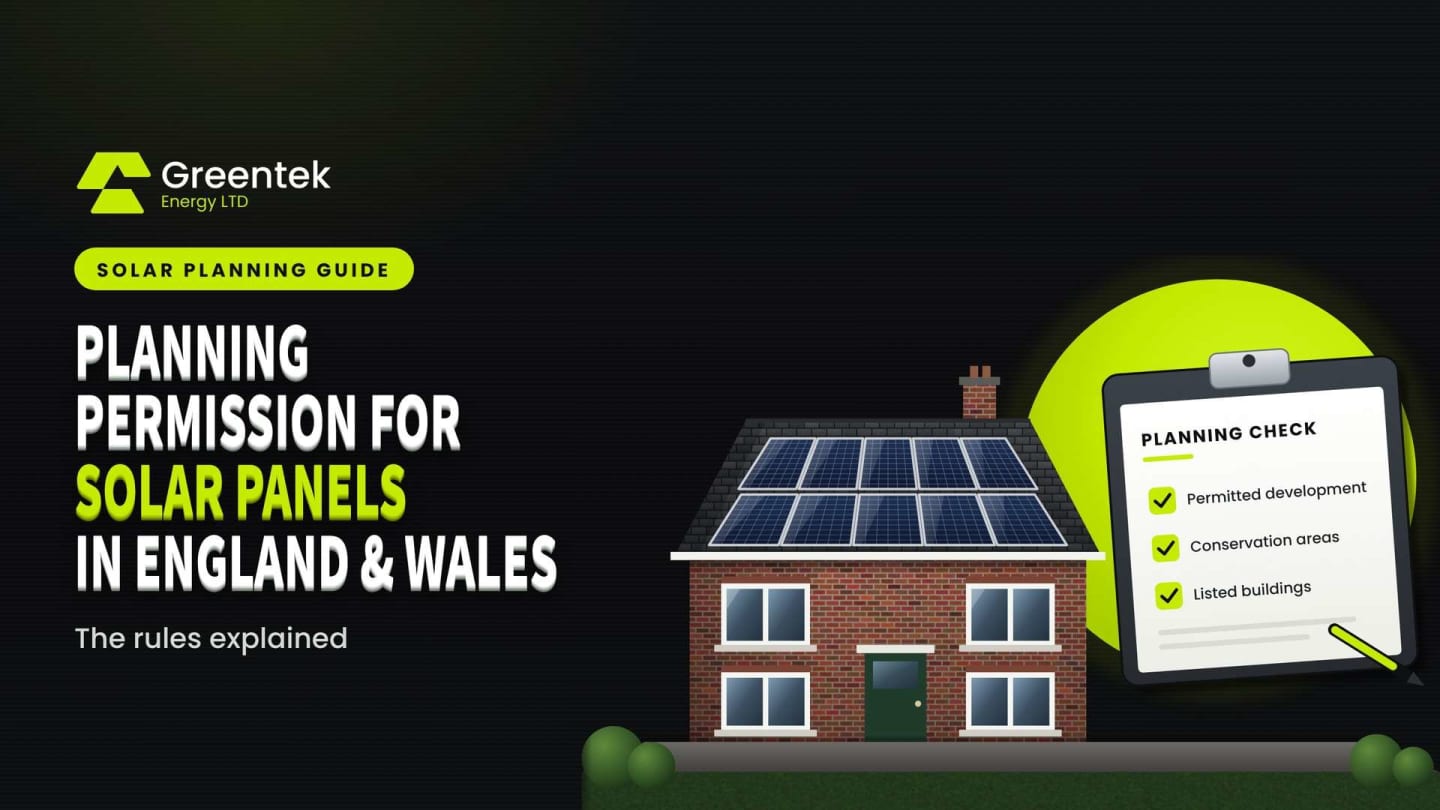
Most homes in England and Wales do not need planning permission for solar panels. Rooftop panels usually count as permitted development, which means you can install them without applying to the council, as long as they stay within set size limits. The picture changes if your home is listed, sits in a conservation area or has had its permitted development rights removed.
The rules are not identical on both sides of the border. England updated its rules on 27 August 2026, while Wales still follows its own long-standing rules. This guide explains both, along with the grid paperwork and building regulations that apply even when no planning application is needed.
Key Facts at a Glance
| Situation | England | Wales |
|---|---|---|
| Pitched roof | Permitted development if panels project no more than 200mm and stay below the highest part of the roof | Same: no more than 200mm and not above the highest part of the roof |
| Flat roof | Permitted development up to 600mm above the highest part of the roof. Prior approval needed in protected areas | Permitted development if at least 1 metre from the roof edge and no more than 1 metre above the roof |
| Walls | Up to 400mm from the wall, or 200mm where the wall is next to a highway | Up to 200mm from the wall |
| Conservation area | Roof panels allowed within limits. No panels on a wall, balcony or roof enclosure facing a highway | Permission needed for panels on a front or side wall facing a highway |
| Listed building | Listed building consent needed. Outbuildings in the grounds are not covered | Planning permission and listed building consent likely to be needed |
| Plug-in (balcony) solar | Permitted development since 27 August 2026, except on timber surfaces | No equivalent planning change. Check with your council |
| Grid notification | G98 within 28 days for most homes, or G99 approval before installing larger systems | Same rules apply |
| Building regulations | Roof strength and electrical work must comply | Same principles apply |
Do You Need Planning Permission for Solar Panels?
In most cases, no. Panels on the roof of a house are normally covered by permitted development, as long as they meet the size limits and conditions set out below. You need to apply if your home is listed, if the panels go beyond the limits, or if your council has removed permitted development rights for your street or estate.
What Does Permitted Development Mean?
Permitted development is a set of national rules that lets you carry out certain types of work without a planning application. In England, the rules for solar panels sit in Part 14 of the General Permitted Development Order. In Wales, they sit in Part 40 of the Welsh version of the same order.
Permitted development is not a blanket approval. Every installation must meet the limits and conditions for that type of work. Two conditions apply to all rooftop solar in both countries:
- Panels must be sited, as far as practicable, to keep their effect on the look of the building and the area to a minimum.
- Panels that are no longer needed must be removed as soon as reasonably practicable.
The second condition is easy to overlook. If panels stop working and are left in place for years, they technically fall outside the rules. Our guide to solar panel maintenance and how long panels last explains how to keep a system working for as long as possible.
When Will You Need to Apply?
You will usually need planning permission, listed building consent or prior approval if:
- Your home is a listed building, or the panels would go on a building in the grounds of a listed home.
- The panels would stick out further, or sit higher, than the limits allow.
- Your home is in a conservation area and the panels would go on a wall facing a road.
- Your council has made an Article 4 direction that removes permitted development rights in your area.
- The original planning permission for your home removed permitted development rights. This is common on newer estates.
- You live in a flat in Wales, where the domestic rules only cover houses.
If you are not sure, you can apply to your council for a Lawful Development Certificate. It is optional, but it gives you written proof that the work is lawful. That can be useful when you come to sell. The same certificate is often used for other projects, as we explain in our guide to loft conversion permitted development and building regulations.
Solar Panels Permitted Development Rules in England
England's rules for solar panels changed on 27 August 2026. There is a transition period until 27 August 2027, during which you can follow either the earlier rules or the new ones. After that date, only the new rules apply.
What Changed in August 2026?
The update gave homeowners more flexibility. The main changes for houses were:
- Panels on walls can now project up to 400mm, or 200mm where the wall is next to a highway.
- Panels on balconies and roof enclosures are now covered.
- Plug-in solar kits now fall within permitted development.
- The rules for panels in the garden were reworked, with height limits that depend on how close the panels are to your boundary.
Pitched Roofs
This is where most home systems go. On a pitched roof, the panels must not project more than 200mm from the roof slope. They also must not sit above the highest part of the roof, not counting the chimney.
In practice, a standard on-roof system sits well within the 200mm limit. In-roof systems, where the panels replace some of the tiles, sit almost flush with the roof.
Walls, Balconies and Roof Enclosures
On a house in England, panels fixed to a wall can project up to 400mm from it. Where the wall is next to a highway, the limit drops to 200mm. Separate, tighter rules apply to blocks of flats, where panels can project no more than 200mm from the wall or roof slope.
Ground-Mounted Panels in the Garden
Stand-alone panels in your garden are also covered, within limits. The total area must not exceed 9 square metres. The maximum height depends on where the panels sit:
| Position in the garden | Maximum height |
|---|---|
| More than 5 metres from the boundary | 4 metres |
| Within 5 metres of the boundary | 2 metres |
| Within 5 metres of the boundary and in front of the house | 1 metre |
| In a conservation area and nearer the highway than the house | 2 metres, and prior approval is needed |
In protected areas, garden panels within 5 metres of the boundary need prior approval. In a World Heritage Site, they must be at least 5 metres from the boundary. Ground-mounted panels are not permitted development within the boundary of a listed building.
Solar Panels Permitted Development Rules in Wales
Wales has its own rules, which date from 2012 and have not been changed by England's 2026 update. For panels on the wall or pitched roof of a house, the limits are similar to England's:
- Panels must not project more than 200mm beyond the wall or roof slope.
- Panels must not sit above the highest part of the roof, not counting the chimney.
The Welsh Government notes that these rights apply to houses. If you live in a flat, contact your local planning authority before going ahead.
Ground-Mounted Panels in Wales
Stand-alone panels in a Welsh garden are permitted development if all of the following apply:
- It is the only stand-alone installation.
- No part is higher than 4 metres, or 2 metres if it is within 5 metres of the boundary.
- It is not within 5 metres of a highway.
- No single dimension is more than 3 metres and the panel area is no more than 9 square metres.
Solar Panels on Flat Roof Planning Rules
Flat roofs are treated differently in each country. Solar panels on a flat roof are usually tilted on a frame to catch more sun, so they stand higher than panels on a pitched roof.
| Rule | England | Wales |
|---|---|---|
| Maximum height | No more than 600mm above the highest part of the roof | No more than 1 metre above the plane of the roof |
| Distance from the edge | No set distance | At least 1 metre from the outer edge |
| Protected areas | Prior approval needed on article 2(3) land | No prior approval step, but conservation area wall rules still apply |
What Is Article 2(3) Land?
Article 2(3) land is the planning term for protected areas in England. It includes conservation areas, National Parks, National Landscapes (formerly Areas of Outstanding Natural Beauty), the Broads and World Heritage Sites. In these areas, you must ask the council whether it needs to approve the look of panels on a flat roof before you install them.
Practical Points for Flat Roof Installations
A flat roof often suits solar well, because you can choose the angle and direction of the panels. However, the frames need to be secured against the wind. They are either fixed through the roof covering or held down with ballast. Both put extra load on the roof, so the structure needs checking first.
Flat roofs are common on rear extensions. If you are planning one, it is worth designing the roof with solar in mind from the start. Our guide to single storey extension costs in Birmingham covers how roof choices affect your budget.
Solar Panels in a Conservation Area
You can still have solar panels in a conservation area. In many cases you will not need to apply at all. The difference is in where the panels can go without permission.
In England, panels on any roof slope remain permitted development, as long as they meet the usual size limits. That includes a roof slope facing the street. What you cannot do without permission is fit panels to a wall, balcony or roof enclosure that fronts a highway. Panels on a flat roof need prior approval, and garden panels closer to the road than your house also need prior approval.
In Wales, solar panels in a conservation area need planning permission if they go on the main or side wall of the house and face a highway. The same applies to walls of outbuildings that face a highway.
Check for an Article 4 Direction
Many councils use Article 4 directions in conservation areas to protect the character of a street. A direction can remove the right to install solar panels without permission. Your council's website will usually list the areas affected.
Tips for a Smooth Approval
- Put panels on rear or side roof slopes where you can.
- Choose all-black panels, which blend in better with slate and dark tiles.
- Consider an in-roof system that sits flush with the tiles.
- Speak to the council's conservation officer before you apply, if an application is needed.
Solar Panels on a Listed Building
If your home is listed, assume you will need consent. Listed building consent is needed for any work that affects the character of a listed building, and solar panels usually do. In England, permitted development also does not cover panels on outbuildings in the grounds of a listed home, or stand-alone panels within its boundary. The Welsh Government advises that panels on a listed building will need planning permission and are likely to need listed building consent.
This is not a rule to test. Carrying out unauthorised work to a listed building is a criminal offence, and you can be required to undo it at your own cost.
Approval for solar panels on a listed building is often still possible. Councils tend to look more favourably on panels that are out of sight from public view, such as on a rear roof slope, a modern extension or a separate building with its own consent. You can check whether your home is listed on the National Heritage List for England or through Cadw in Wales.
Plug-In Solar: The New 2026 Rules
Plug-in solar, sometimes called balcony solar, became legal across Great Britain on 27 August 2026. These are small kits that plug into a standard socket. The main rules are:
- The kit can feed no more than 800W into your home.
- Only one plug-in kit is allowed per household.
- It must be a complete kit listed as compliant, plugged straight into a wall socket with no extension leads or adaptors.
- It must be registered with your network operator within 28 days, through an online portal run by the Energy Networks Association.
In England, plug-in kits on walls, balconies and roofs now fall under permitted development, but not on wooden walls, timber balconies or timber cladding. Wales has not made an equivalent planning change, so check with your council before fixing a kit to the outside of a Welsh home.
Plug-in kits are a small step. A full rooftop system generates far more electricity and can be paired with battery storage or a heat pump. If you are weighing that up, our guide on how many solar panels you need to run a heat pump shows how the numbers work.
G98 and G99: DNO Notification Explained
Planning is not the only approval to think about. Every solar system that connects to the grid must also be reported to your Distribution Network Operator, or DNO. This is the company that runs the local electricity network. The process you follow depends on the size of the system's inverter, which converts the panels' power for use in your home.
| Detail | G98 | G99 |
|---|---|---|
| Who it applies to | Systems up to 16A per phase, which is 3.68kW on a standard single-phase home supply | Systems above 3.68kW per phase |
| When to apply | Within 28 days of the system being commissioned | Before installation, and you must wait for approval |
| Typical timescale | Notification only | Often around 4 to 8 weeks for a decision |
| Who handles it | Your installer | Your installer |
Battery storage counts too. A battery with its own inverter adds to the total, so a solar and battery system can need G99 approval even when the panels alone would not. In some cases the DNO will approve a larger system if the amount it can export to the grid is limited.
G98 and G99 DNO notification is not optional. Without it, your system does not meet the rules, which can cause problems with insurance or when you sell your home. Your energy supplier will usually ask for your MCS certificate before paying you for exported electricity.
Building Regulations for Solar Panels
Even when no planning application is needed, building regulations still apply. They cover safety rather than appearance. There are two main areas.
Is Your Roof Strong Enough?
Panels and their mounting rails add weight to the roof and catch the wind. The roof's ability to carry that load must be checked. On older roofs, some strengthening may be needed before installation. A good installer will look at the roof structure during the survey, not on the day of fitting.
Electrical Work and Certification
Installing solar panels usually involves a new electrical circuit, which makes it notifiable work. There are two ways to comply:
- Your installer belongs to a government-approved Competent Person Scheme and certifies the work themselves.
- Someone submits a building regulations application to your council and building control inspects the work.
Be aware that MCS certification on its own does not allow an installer to self-certify building regulations work. They must also belong to a Competent Person Scheme. Where they do, they must notify the council within 30 days of finishing the work.
Documents You Should Keep
Building regulations for solar panels come with paperwork. Keep these documents together, as buyers' solicitors often ask for them:
- Building regulations compliance certificate
- Electrical installation certificate
- MCS certificate for the system
- DNO acknowledgement of your G98 notification or G99 approval
- Lawful Development Certificate, planning permission or listed building consent, if any applied
How to Check Your Home Before You Install
A few checks before you get quotes will tell you which route applies to your home.
- Check whether your home is listed. Search the National Heritage List for England or Cadw's records in Wales.
- Check for a conservation area or Article 4 direction. Your council's website will have maps of both.
- Check your planning history. Newer homes sometimes have permitted development rights removed by a condition.
- Look at your roof. Note whether it is pitched or flat, which way it faces and whether it has shading.
- Confirm the system size. This decides whether a G98 notification or G99 approval is needed.
- Choose an MCS certified installer. They should handle DNO paperwork and building regulations sign-off for you.
Getting Solar Panels Installed With Greentek
For most homeowners, a planning application will not be needed. The real work is making sure the system fits the limits and the paperwork is done properly. That means checking the roof, confirming the rules for your area and submitting the right grid notification.
Greentek Energy Ltd is an MCS certified installer working across the West Midlands and Wales. As part of our solar PV installations, we check planning requirements during the survey, design the system around your roof and handle the DNO notification and certificates. You can see each stage in our guide to how our home energy improvement process works. If you would like to know what your roof can take, book a free survey and we will talk you through the options.