
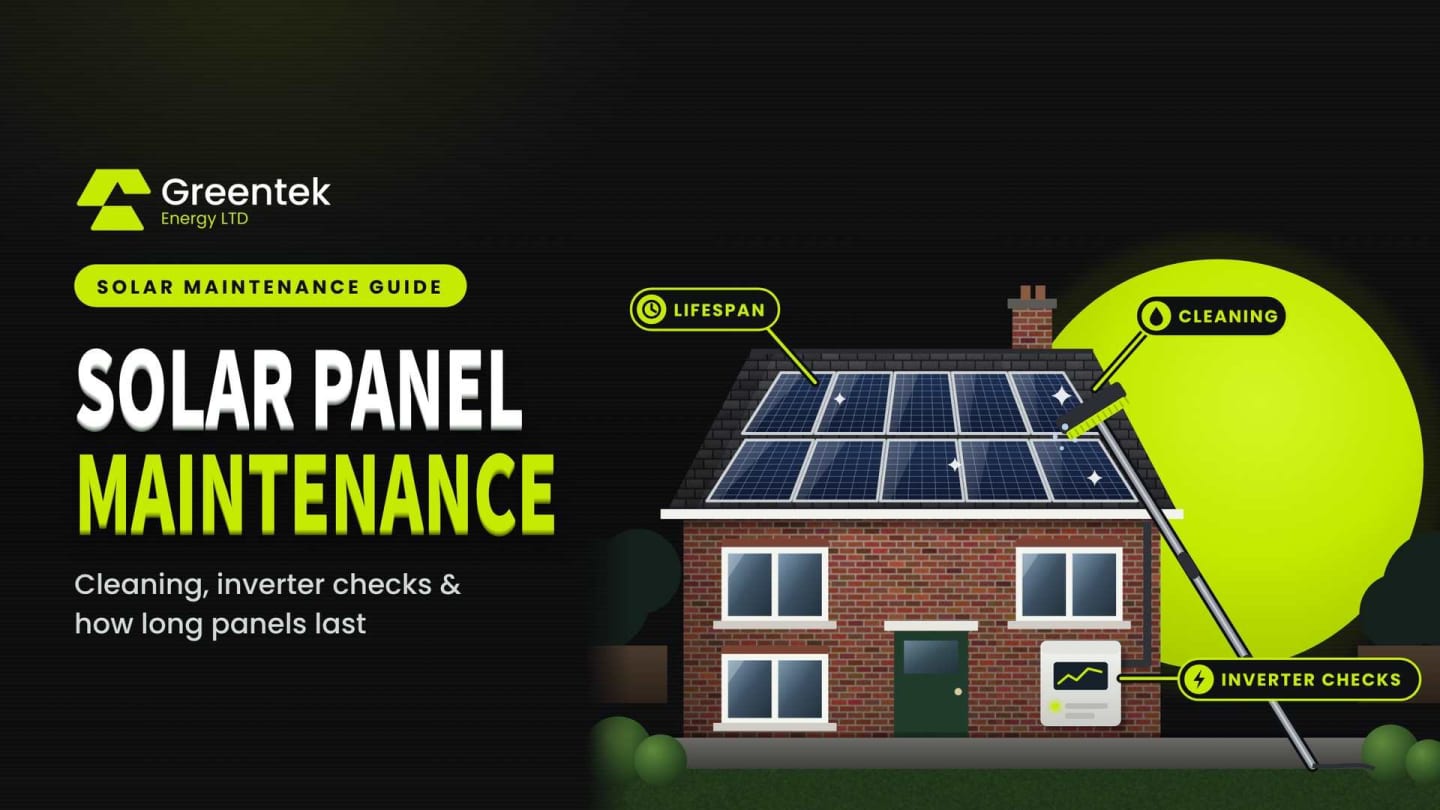
Solar panels need very little maintenance, which is one reason so many UK homeowners choose them. There are no moving parts, and rain does most of the cleaning. Even so, a few simple checks each year help your system produce as much electricity as possible for as long as possible.
This guide covers solar panel maintenance in the UK from start to finish. You will learn how often to check and clean your panels, how to spot an inverter problem early, how to keep pigeons out and how long a typical system lasts. It also explains which jobs you can safely do yourself and which need a qualified installer.
Key Facts at a Glance
| Question | Short answer |
|---|---|
| How often should panels be checked? | Every 12 to 18 months, according to the Energy Saving Trust. |
| How should they be cleaned? | With plain water and a soft brush or sponge. No pressure washers or detergents. |
| How often is a professional service needed? | The Energy Saving Trust recommends a full service every 3 to 5 years. |
| How long do solar panels last? | Around 30 years. Many performance warranties cover 25 to 30 years. |
| How fast do panels lose output? | About 0.5% a year, based on a large study by the US National Renewable Energy Laboratory. |
| How long does an inverter last? | Usually 10 to 15 years. The Energy Saving Trust puts a replacement at around £800. |
| How much does bird proofing cost? | Typically £300 to £1,000, depending on system size and roof access. |
| What is the best early warning sign? | Lower generation than expected in your monitoring app. |
How Much Maintenance Do Solar Panels Need?
Very little. Most homes need a quick visual check every year or so, a clean only when dirt is visible, and a professional service every few years. The most useful habit is checking your monitoring app regularly, because a sudden drop in generation is usually the first sign that something needs attention.
A solar PV system is made up of several parts. The panels get most of the attention, but they are often the most reliable part of the system. The inverter, cabling and roof fixings are just as important.
Which Parts of a Solar PV System Need Attention?
| Component | What can go wrong | How you would notice |
|---|---|---|
| Solar panels | Dirt, bird droppings, lichen, cracks or shading from new tree growth | Lower output, visible marks or damage |
| Roof fixings and mounting rails | Loose brackets after storms, slipped tiles | Rattling, visible movement, roof leaks |
| Cabling and connectors | Wear, water getting in, damage from birds or squirrels | Fault codes, output dropping to zero |
| Inverter | Electronic faults as it ages | Warning lights, error codes, no generation |
| Battery (if fitted) | Gradual loss of storage capacity | Battery empties sooner than it used to |
A Simple Solar Panel Maintenance Schedule
The table below turns the official guidance into a plan you can follow. Most of these jobs take a few minutes. Anything that involves working at height or touching electrical parts should be left to a qualified installer.
| How often | What to do | Who does it |
|---|---|---|
| Monthly | Check generation in your monitoring app and compare it with the same month last year | You |
| After a storm | Look at the roof from the ground for slipped panels, debris or damaged tiles | You |
| Every 12 to 18 months | Inspect panels, fixings and visible cables. Clean if dirt or droppings are building up | You or a professional |
| Every 3 to 5 years | Full professional service, including electrical tests and an inverter check | Qualified installer |
| Around 10 to 15 years | Expect to replace the inverter | Qualified installer |
| 25 to 30 years | Review panel output against the performance warranty | Qualified installer |
The 12 to 18 month and 3 to 5 year intervals come from the Energy Saving Trust. Some installers require a service within a set period to keep the warranty valid, so check your paperwork too. Our guide to how our home energy improvement process works explains the handover documents you should receive.
Cleaning Solar Panels: When and How to Do It Safely
In the UK, rain keeps most roof-mounted panels reasonably clean because of their angle. Clean them only when you can see a build-up of dirt, bird droppings or lichen. Use plain water and a soft brush or sponge, stay on the ground and never use a pressure washer.
Do Solar Panels Need Cleaning in the UK?
Often not as much as people expect. The Energy Saving Trust says rainfall will wash away most dirt and debris on many systems. Ground-mounted panels and very shallow roof installations collect more dirt and may need cleaning more often.
Some locations also need more attention. Homes near busy roads, farms, building sites or large trees tend to see more grime and leaf debris. Bird droppings are the biggest problem, because they do not wash away easily and they block light from the cells underneath.
A good rule is to look first and clean second. If your panels look clean from the ground and your output is normal for the time of year, there is no need to clean them.
How to Clean Solar Panels Safely
- Read your installer's or manufacturer's guidance first, as some warranties set out how panels should be cleaned.
- Turn the system off by following the shutdown steps in your manual.
- Stay on the ground. Use a soft brush on a telescopic, water-fed pole rather than climbing a ladder.
- Use plain water only. Washing-up liquid and other cleaning products can leave a residue that affects performance.
- Clean in the early morning or evening. Cold water on hot glass on a sunny day is best avoided.
- Never use a pressure washer, abrasive pads or harsh chemicals. High-pressure water can damage seals and wiring.
- Turn the system back on and check your monitoring app on the next bright day.
Never stand or kneel on panels. The weight can cause tiny cracks in the cells that you cannot see but that reduce output over time.
When Should You Use a Professional Cleaner?
Use a professional if your panels are above single-storey height, if droppings or lichen have built up, or if you cannot reach them safely from the ground. Checkatrade estimates professional cleaning at around £4 to £15 per panel, so a typical 10-panel home system might cost roughly £40 to £150. Price depends on access and how dirty the panels are.
Bird Proofing Solar Panels: Stopping Pigeons Before They Nest
Pigeons like the sheltered gap between panels and the roof. Once they move in, they bring nesting material, droppings and noise. Fitting mesh around the edge of the array is the most common fix. Typical UK prices range from about £300 to £1,000.
Signs You Have a Bird Problem
- Droppings building up on the panels or below them
- Twigs and nesting material poking out from under the array
- Cooing or scratching noises from the roof, especially early in the morning
- Feathers or debris blocking gutters below the panels
Bird problems are more than a nuisance. Droppings are acidic and block sunlight, and nests can trap moisture and damage cables. A build-up of dry nesting material close to electrical connections is never a good idea
Bird Proofing Options Compared
| Method | How it works | Pros | Cons |
|---|---|---|---|
| Bird mesh | A fine mesh clipped around the edge of the panels | Discreet, effective and does not drill into panels | Needs occasional checks |
| Bird spikes | Spikes fixed along edges where birds land | Low cost and quick to fit | Can look unsightly and do not stop birds getting underneath |
| Bird netting | Heavier netting over a wider area | Suits larger birds and bigger roofs | Costs more and needs more upkeep |
For most homes, mesh is the neatest solution. It also helps keep out squirrels, which can chew through cables. Fitting it is a job for a professional with the right access equipment.
Check for Active Nests First
All wild birds are protected by law while they are nesting. Under the Wildlife and Countryside Act 1981, it is an offence to take, damage or destroy a nest while it is in use or being built. If birds are already nesting under your panels, get professional advice before anything is removed. The ideal time for bird proofing solar panels is straight after installation, before any birds have moved in.
Solar Inverter Lifespan: When to Check, Repair or Replace
Most string inverters last 10 to 15 years, so you should expect to replace one during the life of your panels. The Energy Saving Trust puts the cost of a replacement at around £800. Most inverters come with at least a five-year warranty, and many can be extended.
What Does an Inverter Do?
Solar panels produce direct current (DC) electricity. Your home and the grid use alternating current (AC). The inverter converts one to the other, so without it your panels cannot power your home or export to the grid. It is also the part of the system that works hardest, which is why it usually wears out first.
Warning Signs Your Inverter Needs Attention
- A red or orange warning light, or an error code on the display
- Zero generation on a bright day
- Your monitoring app has gone offline or shows gaps
- A buzzing noise or more heat than usual
- Output that falls suddenly rather than gradually
Most inverters show an error code that points to the problem. Make a note of it, or take a photo, before you call your installer. Do not open the inverter or attempt any repair yourself.
String Inverters, Microinverters and Hybrid Inverters
| Inverter type | Where it sits | What to know |
|---|---|---|
| String inverter | One unit, often in the loft or garage | The most common type. Usually replaced once in a system's life |
| Microinverters | One small inverter behind each panel | Usually carry longer warranties. One fault only affects one panel |
| Hybrid inverter | One unit that also manages a battery | Useful if you want to add battery storage now or later |
Your solar inverter lifespan depends partly on the type you have and partly on where it is fitted. Inverters in hot, poorly ventilated lofts tend to run warmer and age faster than those in cooler spaces.
Repair, Replace or Upgrade?
If your inverter fails in its first few years, it should be covered by the warranty. If it fails after 10 years or more, replacement is usually better value than repair. This is also a good moment to think ahead. Swapping to a hybrid inverter makes it easier to add a battery later, and our guide to whether a solar battery is worth it [future blog link: add once published] explains the pros and cons. Our solar PV installations page covers inverter and battery options in more detail.
How Long Do Solar Panels Last?
Solar panels typically last around 30 years, and many keep working beyond that at a lower output. Most come with two warranties: a product warranty that covers manufacturing faults, and a performance warranty. Reputable manufacturers guarantee at least 80% of the original output after 25 to 30 years.
So how long do solar panels last in practice? The answer depends on panel quality, how well the system was installed and how it is looked after. A well-fitted system that is checked regularly and never walked on has the best chance of reaching or passing the 30-year mark.
Solar Panel Degradation Explained
Solar panel degradation is the slow loss of output that happens as panels age. It is normal and expected. A large study by the US National Renewable Energy Laboratory found a median rate of about 0.5% a year. Other estimates put the range at 0.2% to 0.5%.
At 0.5% a year, here is roughly how much of its original output a panel would still produce:
| Panel age | Approximate output |
|---|---|
| Year 1 | 100% |
| Year 10 | 95% |
| Year 20 | 90% |
| Year 25 | 88% |
| Year 30 | 86% |
These are illustrative figures based on a steady rate of loss. Real panels vary, but the trend is useful for judging whether your system is ageing normally.
What Speeds Up Degradation?
Some problems make panels lose output faster than they should:
- Microcracks caused by people walking on panels, hail or poor handling during installation
- Hot spots, where part of a panel is shaded or covered in droppings and overheats
- Moisture getting into junction boxes or connectors
- Poor installation, such as damaged cables or loose fixings
Faster than normal degradation means buying more electricity from the grid, at a time when energy bills keep rising. Most of these causes are avoidable with careful installation and regular checks.
What Happens After 25 Years?
Your panels do not stop working when the performance warranty ends. They simply produce a little less each year. At that point, you can keep them running or replace them with newer panels that produce more from the same roof space. Old panels should be recycled through the proper electrical waste route, and your installer can advise on this.
Solar Panel Monitoring: How to Tell If Your System Is Working
Solar panel monitoring means tracking how much electricity your system generates, usually through an app linked to your inverter or a generation meter. Check it monthly. Compare each month with the same month last year and with the estimate in your installation paperwork.
What to Check Each Month
- Total generation in kWh for the month
- The same month last year, which is a fairer comparison than last month
- Your installer's annual estimate, usually given in your quote or MCS paperwork
- Export payments, if you are on a Smart Export Guarantee tariff.
If you also run a heat pump, viewing your solar generation and your air source heat pump electricity use side by side shows how much of your heating is covered by your own power.
Understanding Normal Seasonal Changes
Generation in December can be a small fraction of what you see in June. That is normal in the UK and is not a fault. Our guide on how many solar panels you need to run a heat pump looks at winter output in more detail. The key is to compare like with like: this June against last June, not June against December.
When Low Output Means a Problem
| What you see | Likely cause | What to do |
|---|---|---|
| Zero generation on a sunny day | Inverter fault or tripped isolator | Note any error code and call your installer |
| Gradual drop over several months | Dirt, droppings or new shading | Check from the ground and clean if needed |
| Sudden large drop on a bright day | Fault on one string of panels or a damaged cable | Book an inspection |
| App offline but inverter working | Wi-Fi or router change | Reconnect the inverter to your network |
What Should Homeowners Avoid Doing?
Most solar panel problems come from good intentions. A few rules will keep you and your system safe:
- Do not climb onto the roof. Use binoculars from the ground and call a professional for anything else.
- Do not touch damaged cables. Panels produce electricity whenever light falls on them, so the cables on the roof can stay live even when the inverter is switched off.
- Do not open the inverter or try electrical repairs yourself.
- Do not use pressure washers, detergents or abrasive tools.
- Do keep your paperwork together, including your MCS certificate, warranties and inverter manual.
- Do tell your home insurer that you have solar panels, so that you know they are covered.
Keeping Your Solar PV System in Good Shape
Good solar panel maintenance in the UK comes down to a few simple habits. Check your monitoring app each month. Look at your panels from the ground once or twice a year and clean them gently only when they need it. Book a professional service every three to five years, and plan for an inverter replacement somewhere around year 10 to 15.
Protecting your panels from birds early, and never walking on them, helps them reach or exceed their expected lifespan. Keep a simple record of your yearly generation, too. It makes faults easier to spot and gives your installer useful information if something goes wrong.
At Greentek Energy Ltd, our MCS certified team designs, installs and supports solar PV systems for homes and businesses across the West Midlands and Wales. At handover, we walk you through how your system works and what to keep an eye on.