

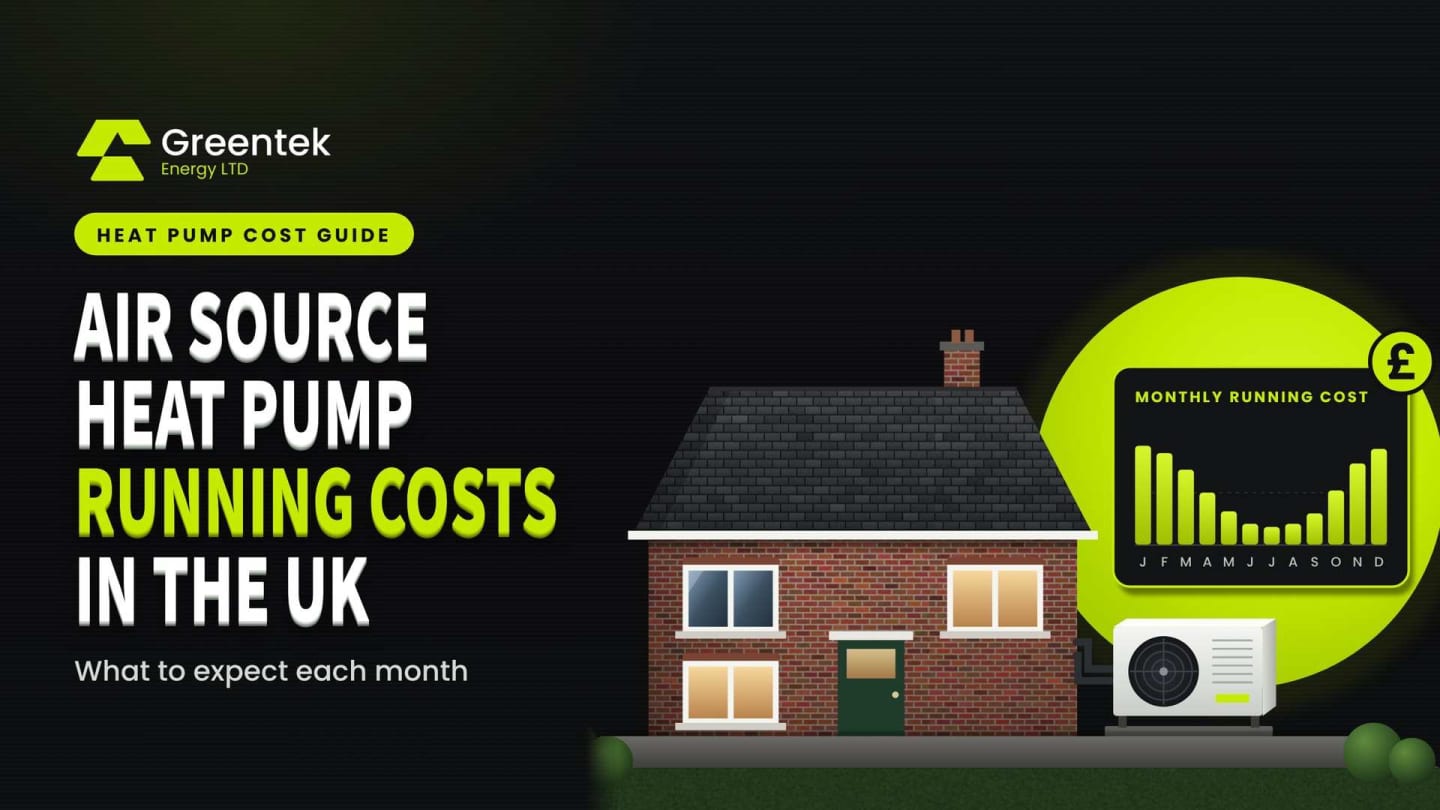
Air source heat pump running costs come down to three things. How much heat your home needs, how efficiently the heat pump makes it and what you pay for electricity. For a typical UK home at October 2026 prices, that works out at about £795 a year, or around £66 a month on average.
That average hides a big seasonal swing. January can cost more than £120, while July and August cost under £20 because the heat pump is mainly heating water. Below, we break the year down month by month, explain what SCOP means for your bill and show the tariff and design choices that bring costs down.
Key Facts at a Glance
| Question | Short answer |
|---|---|
| What does a heat pump cost to run each year? | About £795 for a home needing 8,500 kWh of heat, at October 2026 prices. |
| What is the average monthly cost? | About £66, ranging from around £17 in summer to £127 in January. |
| How much electricity does it use? | About 3,000 kWh a year, or 15 to 16 kWh a day in midwinter. |
| What electricity price is used here? | 26.32p per kWh, the Ofgem price cap average from 1 October to 31 December 2026, with no VAT. |
| How efficient are heat pumps in real UK homes | A median of 2.80 across monitored homes, and 2.44 on the coldest days. |
| Is heat from a heat pump cheaper than gas? | At an efficiency of 3.0 it costs about 8.8p per kWh of heat, against about 8.9p from a 90% efficient gas boiler. |
| What cuts running costs most? | A time-of-use tariff, lower flow temperatures and a home that holds its heat. |
How Much Does an Air Source Heat Pump Cost to Run?
Divide the heat your home needs by the heat pump's efficiency, then multiply by your electricity price. A home needing 8,500 kWh of heat a year, with a heat pump averaging 2.8, uses about 3,000 kWh of electricity. At 26.32p per kWh, that comes to about £795 a year.
The Simple Running Cost Formula
Running cost = (heat needed in kWh ÷ efficiency) × price per kWh
Each part of the formula is something you can find or ask about:
- Heat needed is how much heat your home uses in a year for heating and hot water.
- Efficiency is how many units of heat the heat pump makes from one unit of electricity.
- Price per kWh is the unit rate on your electricity tariff.
If you have a gas boiler now, your gas bill gives you a head start. Multiply your yearly gas use in kWh by your boiler's efficiency. A modern condensing boiler is around 0.9, and older boilers are often lower. The answer is roughly the heat your home actually uses. Ofgem's typical household uses 9,500 kWh of gas a year, which is about 8,500 kWh of heat.
Heat Pump Cost per kWh of Heat
The clearest way to compare heating costs is the price of one kWh of heat delivered into your home. For a heat pump, that is your electricity price divided by its efficiency.
| Heating option | Efficiency | Cost per kWh of heat |
|---|---|---|
| Heat pump | 2.5 | 10.5p |
| Heat pump | 2.8 | 9.4p |
| Heat pump | 3.0 | 8.8p |
| Heat pump | 3.5 | 7.5p |
| Heat pump | 4.0 | 6.6p |
| Gas boiler (gas at 7.97p per kWh) | 90% | 8.9p |
The heat pump figures use the October 2026 capped electricity price of 26.32p per kWh. At an efficiency of 3.0, the heat pump cost per kWh of heat is about the same as gas. Every step up in efficiency, or down in electricity price, tips the balance further in the heat pump's favour.
Air Source Heat Pump Running Costs Month by Month
Most of the year's cost falls between November and March. In our example, those five months make up more than two thirds of the annual bill. June to September together cost around £80.
| Month | Heat needed (kWh) | Electricity used (kWh) | Average use per day (kWh) | Estimated cost |
|---|---|---|---|---|
| January | 1,259 | 482 | 15.5 | £127 |
| February | 1,109 | 424 | 15.2 | £112 |
| March | 1,064 | 371 | 12.0 | £98 |
| April | 811 | 257 | 8.6 | £68 |
| May | 550 | 169 | 5.4 | £44 |
| June | 254 | 84 | 2.8 | £22 |
| July | 170 | 63 | 2.0 | £17 |
| August | 170 | 63 | 2.0 | £17 |
| September | 294 | 97 | 3.2 | £25 |
| October | 642 | 206 | 6.6 | £54 |
| November | 950 | 332 | 11.1 | £87 |
| December | 1,228 | 470 | 15.2 | £124 |
| Year | 8,501 | 3,018 | 8.3 | £795 |
How We Worked Out These Figures
These figures are an illustration, not a quote. They show how costs move through the year for a typical home.
- The home needs 8,500 kWh of heat a year. That is 6,500 kWh for space heating and 2,000 kWh for hot water.
- The monthly split follows average monthly temperatures for Great Britain from 1991 to 2020, published by the Department for Energy Security and Net Zero.
- Efficiency ranges from 2.6 for heating in December to February, up to 3.8 in summer. Hot water is set at 2.7 all year. Over the year this averages 2.82, close to the median measured in real UK homes.
- The price is 26.32p per kWh all year. Standing charges are left out, as you pay the electricity standing charge with or without a heat pump.
Your own figures will depend on your home, your heat pump and your tariff. A home with more heat loss, or a tariff with cheaper periods, will look quite different.
Heat Pump Electricity Usage per Day
In our example, heat pump electricity usage per day ranges from about 2 kWh in July to 15.5 kWh in January. On a very cold day it can reach 20 kWh or more. At 26.32p per kWh, a 15.5 kWh day costs about £4.08.
Summer use is low because the heat pump is mostly heating water. In spring and autumn it runs for heating on cool mornings and evenings. If you are thinking about adding solar, our guide on how many solar panels you need to run a heat pump looks at how well generation matches this pattern.
What Is the Cost to Run a Heat Pump in Winter?
In our example, the cost to run a heat pump in winter is about £363 for December to February. That is roughly £4 a day and nearly half the yearly total.
- Three things push winter costs higher than this:
- A colder than average winter, as the heat pump has more heat to make.
- A home with high heat loss, such as uninsulated solid walls.
- Radiators that need a high water temperature to heat the room.
Heat Pump SCOP Explained: What the Efficiency Figure Means for Your Bills
SCOP stands for Seasonal Coefficient of Performance. It is the average amount of heat a heat pump makes for each unit of electricity across a heating season, measured under standard test conditions. A SCOP of 3.0 means 3 kWh of heat for every 1 kWh of electricity. The higher the figure, the lower your bills.
COP, SCOP and SPF: What Is the Difference?
You will see three efficiency terms on quotes and data sheets. Only one of them decides your actual bill.
- COP (Coefficient of Performance) is efficiency at a single moment or test point.
- SCOP is a seasonal figure from laboratory testing. It is usually quoted at a flow temperature of 35°C or 55°C, so check which one you are reading.
- SPF (Seasonal Performance Factor) is the efficiency measured in a real home over a year. This is the number that sets your running costs.
With heat pump SCOP explained this way, the key question for any quote becomes simple. What efficiency will this system achieve in my home, at the flow temperature it needs?
Why Flow Temperature Matters So Much
Flow temperature is the temperature of the water the heat pump sends to your radiators or underfloor heating. The lower it is, the less work the heat pump has to do. That is why the same heat pump can have a SCOP above 4 at 35°C and closer to 3 at 55°C.
Why Radiator Size Affects Your Bills
Larger radiators and underfloor heating give off the same heat at a lower water temperature. That lets the heat pump run at a lower flow temperature and use less electricity. A room-by-room heat loss calculation shows which radiators can stay and which need upgrading. It is part of the survey stage in how our home energy improvement process works.
What Do Real UK Homes Achieve?
The Electrification of Heat Demonstration Project monitored 742 heat pumps in a wide range of British homes. Energy Systems Catapult reported a median efficiency of 2.80 for air source heat pumps. Well-designed systems with lower flow temperatures often do better than this.
When we plan an air source heat pump installation, the system is sized from your home's heat loss. An MCS certified installer should also give you a written performance estimate. Ask for it, and ask what flow temperature it assumes.
Heat Pump Efficiency in Cold Weather
Heat pumps lose some efficiency as the temperature falls, but less than many people expect. In the Electrification of Heat project, the coldest days had average daily temperatures as low as minus 6°C. On those days the median air source heat pump still achieved 2.44, against 2.80 across the whole monitoring period.
Why Heat Pump Efficiency in Cold Weather Drops
There are two main reasons efficiency dips in winter:
- Less heat to collect. Colder air holds less heat, so the heat pump works harder to extract it.
- Higher flow temperatures. On cold days the system may need warmer water to keep rooms comfortable.
You may also notice defrost cycles. When frost builds up on the outdoor unit, it briefly reverses to melt the ice. You might see steam rising from the unit. This is normal and only lasts a few minutes.
How to Keep Winter Running Costs Down
Small habits make a real difference to winter bills:
- Use weather compensation, which lowers the flow temperature automatically on milder days.
- Let the heat pump run steadily rather than switching it off and on.
- Avoid large overnight temperature drops that need a hard reheat in the morning.
- Keep leaves, snow and clutter clear of the outdoor unit.
- Heat your hot water during cheaper tariff periods.
A home that loses heat slowly also needs less from the heat pump on the coldest days. Our guide on how to make a house warmer without turning up the heating covers the main fixes.
Which Heat Pump Tariff in the UK Saves the Most?
A heat pump tariff gives you cheaper electricity at set times of day. The best one depends on when your heat pump runs and how well your home stores heat. In October 2026, cheaper-period rates on these tariffs were often around half to two thirds of the standard capped rate.
How Heat Pump Tariffs Work
Most tariffs aimed at heat pump owners use cheaper time windows. Some also charge more at the early evening peak. Examples on offer in October 2026 included Cosy Octopus, British Gas Heat Power, EDF Heat Pump & Save and E.ON Next Pumped.
Terms differ between suppliers. Some need a smart meter, some are only open to existing customers, and rates follow the price cap or the supplier's own index. Tariffs change often, so compare current rates for your region before you switch.
Using Your Home and Hot Water Cylinder as a Store
You do not need a battery to benefit from cheaper tariff periods. A hot water cylinder can be heated during a cheap window and hold that heat for hours. A well-insulated home can also be warmed slightly before the evening peak, then coast through it with little or no heating.
What a Cheaper Rate Could Save
Our example home uses about 3,000 kWh of electricity a year. Here is how the price you pay changes the yearly bill:
- At 26.32p per kWh (the October 2026 cap): about £795.
- At an average of 20p per kWh: about £603.
- At an average of 15p per kWh: about £453.
Your average depends on how much of your use falls in cheaper periods. Choosing the right heat pump tariff in the UK market is often the single biggest saving after good system design.
How Do Heat Pump Running Costs Compare With a Gas Boiler?
At October 2026 prices, the two are close. A typical home spends about £757 a year on gas units, plus around £108 in gas standing charges. The same home with a heat pump would spend about £795 at the standard capped rate, or about £603 if it paid an average of 20p per kWh.
| Option | Yearly energy cost | Notes |
|---|---|---|
| Gas boiler, 9,500 kWh of gas at 7.97p | £757 plus £108 gas standing charge | Electricity standing charge is paid as well |
| Heat pump at 26.32p per kWh | £795 | No gas standing charge if the gas supply is capped |
| Heat pump at an average of 20p per kWh | £603 | Depends on using cheaper periods |
Standing Charges: The Hidden Saving
The gas standing charge under the October 2026 cap is 29.68p a day, which adds up to about £108 a year. You only save this if you have your gas supply capped. If you keep gas for a hob, the standing charge stays.
VAT and Price Changes
From 1 October 2026, the government removed VAT from household electricity bills, funded for the 2026 to 2027 financial year. If 5% VAT returns, the 26.32p rate would rise to about 27.6p. That would add around £40 a year to our example. The price cap itself also changes every three months.
What Makes Running Costs Higher or Lower?
Two homes with the same heat pump can have very different bills. These are the factors that matter most:
- Heat loss. A draughty home or uninsulated walls need more heat. For older solid wall homes, external wall insulation can cut that demand a lot.
- System design. A correctly sized heat pump and suitable radiators allow lower flow temperatures.
- Controls. Weather compensation and sensible schedules keep efficiency high.
- Hot water use. Large households using lots of hot water will see higher summer costs.
- Tariff. The price you pay per kWh can change the yearly bill by hundreds of pounds.
- Installation quality. Insulated pipework and a well-commissioned system protect efficiency for years.
Signs Your Heat Pump Is Costing More Than It Should
If your bills are higher than the estimate you were given, check these common causes:
- The backup immersion heater is running too often. It turns 1 kWh of electricity into only 1 kWh of heat, so it costs about three times as much as the heat pump for the same heat.
- The flow temperature is set too high. This is common after an engineer turns it up to fix one cold room.
- The heat pump is short cycling. Frequent stops and starts can point to an oversized unit or closed radiator valves.
- The weather was colder than usual. A cold winter raises use even when the system is working well.
To judge this fairly, compare your use in kWh rather than pounds and allow for the weather. We explain how in our article on checking whether your home is warmer and more efficient. If the numbers still look wrong, ask your installer to review the settings.
Planning a Heat Pump With Running Costs You Can Trust
National averages are a useful starting point, but your home is what counts. Before you commit, ask for figures based on your own property:
- A room-by-room heat loss calculation.
- A written MCS performance estimate, including the flow temperature it assumes.
- A plan for any radiators that need upgrading.
- Advice on tariffs that suit how you live.
- Honest guidance on whether insulation should come first.
Greentek Energy Ltd designs and installs air source heat pumps for homes and businesses across the West Midlands and Wales. Our in-house team carries out the survey, fits the system and sets it up for efficient running. If you would like real figures for your own home, book a free survey.